
FAS Fraud: How to Detect and Address Hidden Revenue Loss

Knowledge base
Share
Spotting False Answer Supervision (FAS) fraud is a lot like finding a needle in a haystack. It often comes without any clear signs and doesn’t fit into any obvious patterns, making it particularly challenging to identify. By the time you realize it’s happening, your losses may already be significant.
FAS occurs when a fraudulent operator manipulates call signaling to make it seem as though a call has reached the intended recipient—although it never did.
Instead of routing the call correctly, the rogue carrier sends a fake “answer” signal to the originating network. This can cause the caller to hear dead air, technical messages, or redirection to fake Interactive Voice Responses (IVRs). From the originating provider’s perspective, the call looks legitimate, resulting in false charges.
Together with call stretching (which inflates the duration of legitimate calls), FAS is one of the most persistent types of interconnect fraud that leads to major financial losses for telecom operators.
FAS is so persistent because it exploits a common industry practice: chasing lower costs by choosing cheaper routes. These less secure routes make it easier for fraud to slip through, and with operators focused on price, FAS often goes undetected.
In this article, we’ll talk about the challenges that FAS presents to telecom operators, how anti-fraud teams can detect this type of fraud, and why traditional detection methods fall short—plus, how you can future-proof your business with the help of applied AI/ML.
What Is False Answer Supervision (FAS)?
FAS is a form of interconnect fraud where a call is billed as “answered” even though it is never actually connected to the destined recipient.
How Does FAS Work?
Essentially, FAS relies on manipulating call signaling. In both legacy (ISUP) and modern (SIP) networks, messages are exchanged between switches to indicate when a call is ringing, answered, or ended.

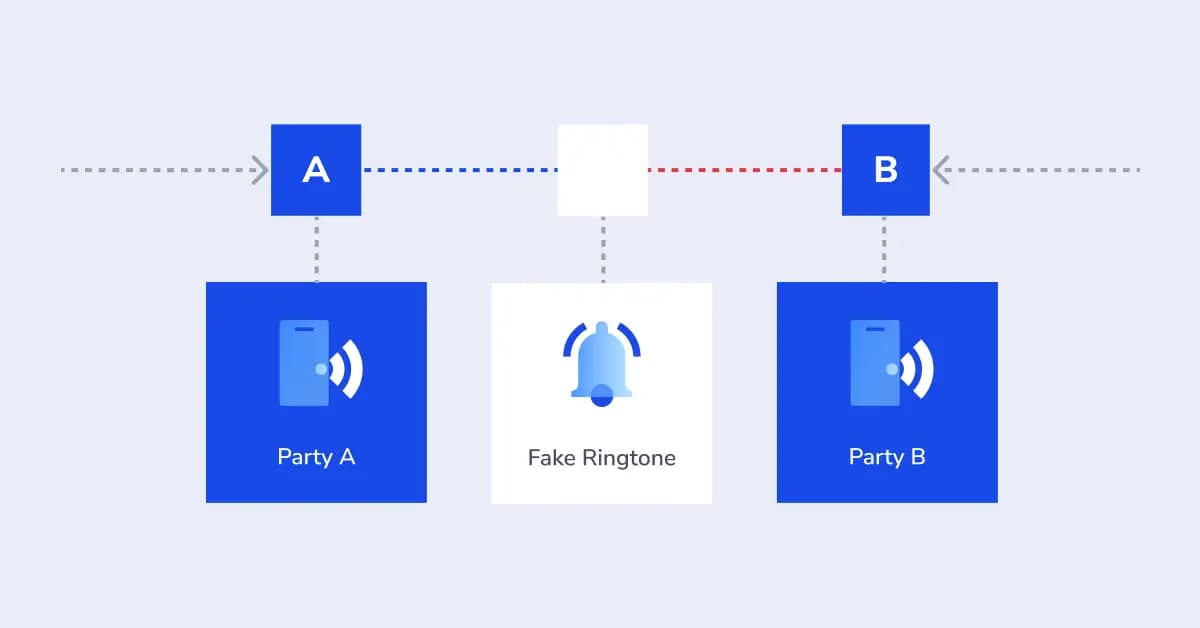
FAS fraud relies on sending fake answer signals, even if a call is never answered by the intended recipient
Fraudsters exploit this by sending a fake “answer” signal (sometimes called an early answer tone) before the call is picked up or even if it’s never answered by the destined recipient at all. As soon as this signal is received, billing starts, effectively charging the operator for “dead air”, without speech path, or even any actual connection or audio.
FAS vs. Call Stretching
Both FAS and call stretching are forms of billing fraud, but while FAS creates fake “answers” for calls that were never picked up by the intended recipient, call stretching manipulates legitimate calls by artificially extending their duration. This might involve adding extra seconds or minutes to calls and correspondingly to the billing records, or playing back the pre-recorded voice of party B to party A.
How Can Telecom Anti-Fraud Teams Detect FAS Today?

While traditional fraud management tools look for clear patterns or threshold-based rules violations, the reality is that FAS rarely leaves obvious clues. There isn’t a single “red flag” that you could identify reliably to spot FAS fraud, but rather, small shifts in traffic statistics, like unusually high answer rates (ASR), or odd changes in Average Call Duration (ACD) on specific routes.
Because FAS can be applied in minute numbers across millions of calls, it can easily blend in with normal traffic. Plus, it may be almost impossible to trace back to a single party or route.
In practice, operators might notice FAS only after customer complaints or by using advanced AI systems to spot anomalies, like routes with inflated pickup rates or unusual call durations. Even then, isolating the source is a major challenge, and the fraud may already have caused significant financial loss before it’s uncovered.
FAS Detection Methods
Some of the key methods used to detect false answer supervision include:
- Test calls and probing: Probing specific routes with test calls and comparing their results to reported billing data enables you to identify mismatches and uncover routes that report false answer events. This approach, however, only enables you to expose FAS routes that you identify, but cannot be scaled and used for 24/7 analytics across your complete route portfolio.
- KPI analysis: Teams can also monitor key metrics like Answer Seizure Ratio (ASR) and Average Call Duration (ACD) for unusual patterns. For example, if all traffic from Operator X to Operator Y suddenly has a much higher answer rate or lower average call duration compared to other routes, this can signal artificially manipulated traffic.
- Customer complaints: Sometimes, the first sign of FAS is a spike in customer complaints, i.e. users complaining about being billed for calls they never answered or experiencing “dead air” after connecting.
- AI and pattern recognition: Leveraging advanced AI/ML systems to monitor traffic in real time enables you to flag anomalous activity and deviations in ASR, ACD, and other KPIs between specific operators or routes. While AI cannot effectively prevent FAS fraud, it can enable telecom operators to detect it in real time and react swiftly.
- Labeling and rerouting: When suspicious patterns are detected, calls could be labeled as disputed, and operators may choose to reroute traffic through different partners to minimize losses.
Why and How Do Traditional Controls Fall Short?
FAS often hides in plain sight and there’s rarely a telltale sign. Traditional fraud management systems rely on threshold-based rules. Given that FAS, on the other hand, is usually applied in small amounts and buried across millions of legitimate calls, making it a classic needle in a haystack problem and exceptionally hard to spot without large-scale, flexible analytics.
Additionally, by applying standard monitoring rules and static thresholds, you might struggle to keep up with fraudsters – who might be very fast in switching tactics. By the time you update controls and identification strategies, fraud schemes might already be updated, slipping past detection.
On top of that, most traditional systems only analyze traffic for individual numbers or single subscribers, either tracking outbound calls from one Calling Line Identification (CLI), number A, or inbound traffic to a single number B.
Detecting FAS requires a much broader view: You need to analyze entire sets of traffic between operators, often across multiple countries. Most existing tools simply aren’t designed to handle network-wide monitoring at scale, and even if you detect signs of FAS, pinpointing who’s responsible for it is not easy. The fraud could originate from the terminating operator or anywhere along a chain of partners, making it hard to stop the fraud or hold the right party accountable. This means that FAS could potentially drain revenue for months before it’s discovered and fully addressed.
To put it simply, without real-time, network-wide visibility and the ability to flexibly analyze huge data sets and react quickly, you might simply be unable to combat FAS effectively. Which makes it clear why an effective detection strategy is key in addressing the issue – but before that, let’s first look at impacts.
What Is the Business Impact of FAS?
The most obvious effect of FAS is that it leads to revenue loss by billing operators for calls that were never actually connected to the destined recipient. Even if it only affects a small share of traffic, the overall impact adds up quickly – and sometimes the share might not actually be that small. In a case we studied recently, FAS accounted for 6% of total calls and resulted in losses of tens of thousands of dollars.
For originating service providers, FAS is particularly costly because they lose revenue at retail rates, which are significantly higher than wholesale rates. When subscribers are charged for calls that never connected to the intended recipient, it can lead to disputes with the provider, reputational damage, and increased customer churn.
Terminating service providers are also affected: since FAS calls never reach their networks, they never receive legitimate revenue for that traffic. This can create disputes and strain relationships between operators and their interconnect partners. Indirectly, persistent FAS can damage an operator’s reputation and create long-term friction across the entire telecom ecosystem.
On top of all that, regulators like the FCC, Ofcom, and GSMA are putting increased pressure on operators to address fraud and revenue leakage in their networks.
How Can Telecoms Future-Proof Their Business Against FAS Fraud?

FAS is just one example of the many types of fraud that operators deal with – and that lead to tens of billions in lost revenue globally. As telecom networks move to VoLTE, SIP interconnects, and newer technologies, fraud tactics are also changing. This means that using high-quality, reputable carriers remains one of the most effective ways to reduce fraud risk in the delivery chain.
On top of that, accurate and adaptable fraud detection is essential – and should be seen as both a revenue booster and a safeguard for an operator’s revenue and partners’ and customers’ trust, rather than an expense or a barrier to business growth.
Advanced AI systems, when established and trained on large datasets and to high standards, give you the best chance to prevent fraud effectively, by ensuring not only that you’re using the right tools, but also that they’re properly integrated and supervised.
For this, scalable solutions like AB Handshake’s AI Shield are essential, as they’re designed to adapt to multiple fraud types and work across all network technologies, from traditional circuit-switched 2G/3G to IP-based 6G.
Protect Yourself Against FAS and Other Telecom Fraud With AI Shield

Managing fraud like FAS is a challenging task, and especially as fraud tactics become more sophisticated. Manual checks and simple monitoring can only get you so far – according to CFCA’s data, 58% of operators today use outdated tools that lack precision or adaptiveness, and 89% review their fraud control thresholds weekly or less frequently. This is why tools that offer real-time, AI/ML-powered analytics are essential in enabling you to spot issues early and respond effectively to FAS and all major voice fraud types, such as Wangiri & Wangiri 2.0, PBX hacking, robocalls, spam calls, and more.
AB Handshake’s AI Shield is designed for this challenge. Our AI-powered fraud management system (FMS) monitors both incoming and outgoing traffic in real time and analyzes call signaling and patterns between endpoints. This allows you to quickly identify and flag suspicious activity, such as false answer codes or sudden shifts in answer rates.
Each deployment can be tailored to your policies and network, offering real-time visibility to help your fraud team react quickly, and giving you immediate evidence to support rerouting traffic, dispute charges, and reduce your losses. Over time, tracking changes in key metrics like ASR helps you assess whether fraud controls are fine-tuned and working effectively.
Ultimately, operators relying on less secure but cheaper routes are most exposed to FAS and similar risks. Investing in robust, AI-driven monitoring like AI Shield helps close the gap, protecting both revenue and customer trust.
If you’re dealing with ongoing disputes over traffic and billing, now’s the time to implement a powerful monitoring solution to help your team stay ahead of FAS and all other major fraud threats across inbound and outbound traffic.
Contact us to learn how AI Shield can protect your network against fraud and to schedule a demo with our team.